How a 200-Year-Old Physics Law Ended Up in My Drone Data
By Kevin Robles
This summer, as part of my research as a CROPPS REU student, I spent much of my time looking at numbers collected by drones flying over a maize field. Each flight produced a new picture of how the plants were changing, but the numbers did not explain themselves. To understand what was happening in the field, I had to connect the drone images to something less visible: the amount of leaf material growing above the soil. The idea that helped me make that connection came from a place I did not expect.
Source: Nicolas Halftermeyer, Wikimedia Commons
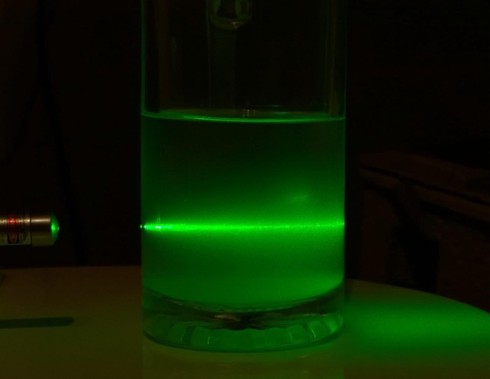
Before changing my major, I began college in chemical engineering, where I learned about the Beer-Lambert law in chemistry. The law states that when light passes through something that can absorb it, less light comes out on the other side. A darker or more concentrated material absorbs more light than a lighter-colored or less concentrated one, and a longer path gives the light more chances to be absorbed.
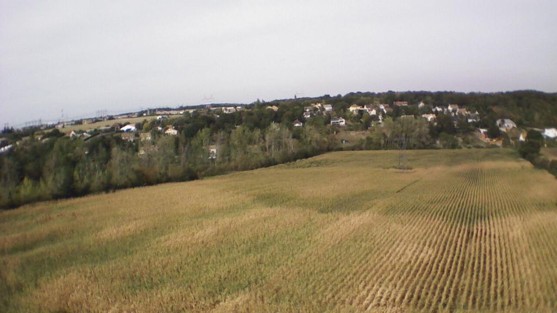
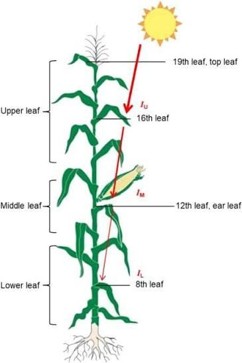
At first, that concept seemed far removed from drone imagery and agriculture. But while a maize field is not a test tube, the same basic idea still applies. Sunlight reaches the top leaves first, then travels through the leaves below them. Every layer blocks part of the light. A field with only a few small leaves lets much of the sunlight reach the soil, while a thick canopy blocks much more of it. That simple connection between leaves and light became one of the most useful parts of my project.
Source: Dinesh Dhankhar, Wikimedia Commons
Plant scientists often describe canopy size using the Leaf Area Index, usually shortened to LAI. LAI compares the total area of leaves with the area of ground beneath them. A low LAI means the canopy is still thin, while a higher LAI means there are more layers of leaves covering the same patch of soil. This matters because leaves capture the sunlight a plant uses for growth, so changes in LAI tell us a great deal about how the crop is developing across the season.
Measuring every leaf by hand would take an enormous amount of time, especially across many plots and repeated visits. The drone images give us a value called the Normalized Difference Vegetation Index (NDVI), which provides a quick picture of how green and covered the field appears from above.
Source: Tian et al., Frontiers in Plant Science, via ResearchGate
NDVI is helpful, but it is not the same thing as LAI. Early in the season, both tend to rise as the plants grow. Later, when the canopy becomes thick, NDVI begins to level off even though the plants may still be adding leaves. It is similar to a camera that can clearly tell the difference between a nearly-empty room and a half-full room but has trouble telling the difference between a crowded room and an even more crowded one. The signal is still useful, but it stops showing every change with the same clarity.
The Beer-Lambert law gave us a way to deal with that problem. Instead of treating the drone value as a direct measurement of leaf area, we used the way leaves block light to estimate how much canopy was present. The reasoning is the same as in chemistry. When more leaf material sits between the sunlight and the ground, less light passes through.
What I worked on this summer
My REU project this summer built on a modeling pipeline created by a previous REU student, Leland Russell. I am using information from twelve drone flights to create canopy growth curves for the maize plots. Those curves show when the plants grew quickly, when they reached their largest canopy, and how they changed near the end of the season. Later, those patterns can connect to the final yield of each plot.
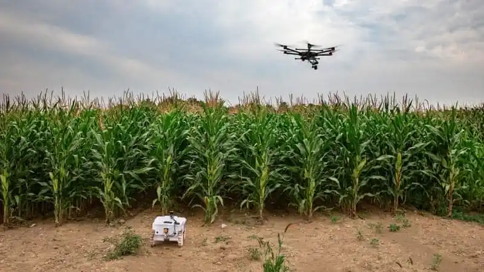
Anna Birn, CornellCALS
A large part of my work involved checking whether the earlier steps behaved the way we expected. The most noticeable problem appeared late in the season, when the plants began to age and lose green leaf material. This stage is called senescence. The original pipeline often estimated the canopy as being smaller than it should have been during that period, which pulled the entire growth curve downward.
Finding that problem required more than changing one number. I had to look at the assumptions behind the conversion from drone measurements to LAI, compare the estimated curves with the seasonal pattern we expected to see, and identify where the method stopped matching the field. The Beer-Lambert relationship was still useful, but the field did not follow the clean conditions of a chemistry experiment. Leaves change color, dry out, overlap, and sit at different angles, while sunlight and image quality also vary between flights. The model had to account for the fact that a living canopy is less predictable than a liquid in a glass container.
Connections Across Disciplines
My training is in data science and psychology rather than plant science, and that shapes how I approach a problem like this. I tend to ask whether a model’s assumptions actually hold in the setting where it is being applied, instead of trusting it because the mathematics is elegant. The Beer-Lambert law was not developed with agriculture in mind. But a canopy transmits light closely enough to the way a solution does that the law was worth testing, and with the right corrections, it holds up.
The later stages of the project, growth-curve modeling and the final yield prediction, are still in progress, so I do not have final results to report. Even so, this is the piece of the work I return to most often when I explain the project, because it shows how directly a two-hundred-year-old physical law can answer a question in a modern cornfield.
About the Author
About the author
I am a rising senior at the University of Arizona, double majoring in Information Science (Data Science emphasis) and Psychology, with minors in Statistics & Data Science and in Spanish, through the W.A. Franke Honors College. This summer, I was a CROPPS REU intern at the Boyce Thompson Institute and Cornell University, funded by the Center for Research on Programmable Plant Systems (CROPPS) and mentored by Professor Kelly Robbins and PhD student Dinesh Ghimire. Please feel free to reach out with any questions at kevinrobles1@arizona.edu. Thank you for reading about my research.